Contrasting results for Russia and Israel in trying to win back friends through sport
JAMES M DORSEY —- Russia and Israel share a common problem: much of the international community views them as regional brutes and occupiers of other people’s lands. To address the problem, both use fog to gain lost ground in their information wars. In sports, the difference is that Russia is gaining ground, Israel isn’t.
The reason is that Russia plays offence, while Israel, unlike in kinetic battlefields, plays defence, attempting to taint its detractors as anti-Semites.
Russia and Israel are fighting different battles. Russia is attempting to roll back sports boycotts, while Israel is seeking to prevent the imposition of sanctions and is banking on the international sports community’s double standards.
Russia has advanced significantly in fighting sanctions, while Israel, at best, has prevented worse from happening in a world in which sports is a theatre in a war to win hearts and minds, garner support of significant segments of the international community, and boost morale at home.
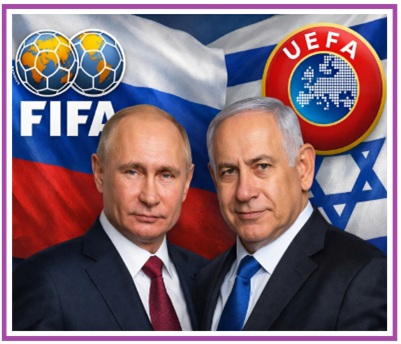
In various disciplines, Russia has succeeded in countering Western efforts to isolate it, dating back to its 2014 annexation of Crimea and the fostering of armed separatist movements in Donetsk and Luhansk.
Earlier this month, Russia scored a key legal victory with a Court of Arbitration for Sport (CAS) decision to overturn the International Ski and Snowboard Federation or FIS’s ban on Russian and Belarusian athletes from its tournaments that include Olympic qualifiers for the Milano Cortina 2026 Olympic and Paralympic Winter Games in the Italian fashion capital.
The federation runs six Olympic sports – alpine skiing, cross-country skiing, freestyle skiing, ski jumping, Nordic combined, and snowboarding – which together account for half of the gold medals at the Winter Games.
Court ruling
In October, the court ruled in favour of reinstating Russian lugers. The ruling enabled six Russian lugers to register as individual athletes to compete in a World Cup event at Mount Van Hoevenberg near Lake Placid, New York, in the hope they would qualify for the Milano Olympics.
The string of Russian successes doesn’t stop there.
The International Olympic Committee recommended, days after the court decision against the ski and snowboard federation, that Russians return with their national flag and anthem to all junior competitions, including team sports.
Last month, the International Judo Federation, whose president, Romania’s Marius Vizer, is close to Russian President Vladimir Putin and a judoka himself, reinstated Russia with its anthem and flag.
Since then, Russian judokas have won three gold medals at the Abu Dhabi and Tokyo Grand Slams, with the country’s national flag displayed and its anthem played at the award ceremonies.
Federations’ stance
Even FIFA, the world governing body, and UEFA, FIFA’s European constituent, are reviewing their bans on Russia.
FIFA recently announced that its new under-15 competitions will “be open to all 211 FIFA member associations.”
At the same, European soccer body UEFA is considering whether to reverse Russia’s ban from European football, despite staunch European support for Ukraine and dim prospects for an end to the war.
The Russian successes in combatting sport boycotts are the product of a multi-year lobbying campaign with Russian envoys travelling across the globe to meet with international and national sports organisations.
Trump factor
Russian sources believe that Donald Trump’s return to the White House has made a difference.
“Trump is shifting the paradigm. The Milano games are the prelude. He is likely to allow Russian athletes to return in full glory with their flag and national anthem in the 2028 Los Angeles Olympics,” one source said.
“For Putin, that would be an enormous victory,” the source added.
Victory for Israel is preventing the imposition of boycotts. The problem is that Israel’s arguments are running thin because of its conduct of the Gaza war and ceasefire violations, and conflation of criticism of the Jewish-majority state’s policies with anti-Semitism.
Like with Russia, Mr. Trump makes a difference.
Mounting disagreements between Israeli Prime Minister Binyamin Netanyahu and Mr. Trump over the implementation of the president’s Gaza ceasefire plan again raise the spectre of members of the global sports community acting after two years of stalling calls by Palestinians and others for a boycott of Israel.
Israel has sought to taint those calls by describing them as anti-Semitic and blood libels. So far, its tactics have worked. The question is for how long.
UEFA was close to calling a vote in September on the suspension of Israel’s membership that stood a chance of being adopted, but shied away from tabling a resolution in its executive committee once Mr. Trump negotiated a fragile Gaza ceasefire.
UEFA meeting
Since then, UEFA executives have met with pro-Palestinian activists. The executives reportedly asked the activists to canvass insights from human rights experts to help inform their future decision-making.
The UEFA request is more than an effort to placate the activists, with the European soccer body facing legal challenges to its hesitancy to sanction Israel.
Internally, the Irish football association has submitted a brief that argues that the European body is legally obligated to take steps because Israel fails to implement anti-racism measures and allows West Bank teams to compete in Israeli leagues, despite objections by the Palestinian soccer federation.
The Israeli Football Association (IFA) recently sought to undermine the Irish argument by approving stricter penalties for racist offenses committed by individual fans, crowds, or teams in line with a FIFA directive.
Meanwhile, activists have filed a similar case in a Swiss court, asserting that authorities should strip the Bern-based UEFA of its tax-free status in Switzerland if found guilty of breaching international law.
Ceferin view
UEFA president Aleksandr Ceferin is empathetic to the plight of the Palestinians.
In August, UEFA unfurled a banner with the message “Stop Killing Children. Stop Killing Civilians” on the pitch of a Super Cup match between Paris Saint-Germain and Tottenham.
Two Gazan children participated in the award ceremony alongside Mr. Ceferin.
“The message is loud and clear,” UEFA said on X.
The banner violated a FIFA ban on political expressions on the pitch but drew little response from the world soccer body.
At the end of the day, Israel’s future in international sports is likely to come at a price determined by whether Mr. Trump successfully pressures Mr. Netanyahu to make the concessions necessary for the implementation of the second phase of his Gaza ceasefire plan.
For now, the ceasefire, despite daily Israeli violations, has produced fragile initial sports dividends for Israel.
Foreign basketball teams returned to Israel this month to play competition matches against their Israeli counterparts for the first time since Israel’s wars began more than two years ago.
The teams returned because of the significantly reduced risk of Hamas, Lebanese Shiite militia Hezbollah, Houthi rebels, and Iran firing rockets, missiles, and attack drones at Israel.
Such dividends could vanish from one minute to another if the second stage of the Trump plan fails to materialise.
Boycott calls
Moreover, refusing to play in a country involved in a war is one thing; facing calls for boycotts because of violations of international law and United Nations Security Council-mandated ceasefires, and the perceived targeting of civilians, is another.
All of which makes for a stark comparison between Russia and Israel.
While Russia is beating the storm despite its invasion of Ukraine and conditions for a ceasefire that would reward it for its aggression, Israel risks resembling the legendary Dutch boy who plugged a leak in a sea wall with his finger to prevent flooding.
Dr James M. Dorsey is an Adjunct Senior Fellow at Nanyang Technological University’s S. Rajaratnam School of International Studies, Contributing Editor to WhoWhatWhy, and the author of the syndicated column and podcast, The Turbulent World with James M. Dorsey
######