Now we can really cash in on the World Cup, says Infantino in plotting FIFA rights sell-off
KEIR RADNEDGE COMMENTARY —- FIFA president Gianni Infantino is proposing to follow up the World Cup’s American extravaganza by, in effect, taking the greatest prize in world football to the commercial market.
Infantino is confident a majority of his 211 member associations will approve the transfer of commercial rights to the World Cup and other flagship tournaments into a new $20bn (£15bn) business capable of selling stakes to private investors.
This is by far the closest the governing body has ever come to privatising the commercial engine of the world’s biggest sporting event. FIFA insists it will retain full regulatory control of football and sell only minority, non-controlling interests in the new company. Critics argue the distinction is largely academic.
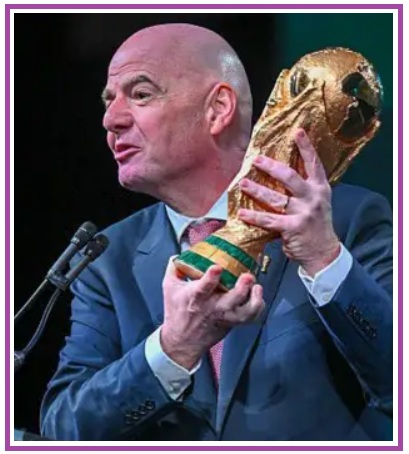
For the first time, investors would be able to buy into the revenues generated by the World Cup itself.
The new subsidiary, to be known as FIFA Forward Enterprise (FFE), would house the commercial operations of the men’s and women’s World Cups, the expanded Club World Cup and other FIFA competitions.
Valued at approximately $20bn, the company aims to raise as much as $4.2bn from outside investors, with FIFA promising that the proceeds would dramatically increase funding distributed to its 211 member associations.
Supporters within FIFA describe the proposal as a logical evolution of the governing body’s finances, unlocking the value of football’s most lucrative assets while maintaining institutional control.
Exploitation
Opponents see something altogether different.
In practical terms, they argue, FIFA would be separating the commercial exploitation of the World Cup from the governing body itself. Although FIFA would continue to write the rules, organise tournaments and regulate the game, the financial incentives behind its flagship competition would increasingly belong to institutional investors expecting long-term returns.
For many within football, that crosses a philosophical line.
No opposition was more immediate or more forceful than UEFA’s.
European football’s governing body issued an extraordinary public rebuke within hours of the announcement, accusing FIFA of attempting to commodify a sport that belongs to nobody.
“It is not FIFA’s to sell,” UEFA declared.
In an even sharper warning, UEFA said the proposal “crosses a line that football’s governing institutions should never cross,” adding that “the soul and governance of football are not assets to trade” and criticising the absence of transparency over who ultimately benefits financially.
UEFA disagreements
The unusually confrontational language illustrates just how seriously UEFA views the proposal.
Relations between FIFA and UEFA have often been strained during Infantino’s presidency, from disagreements over the expanded Club World Cup and international calendar to governance reforms and commercial strategy.
Yet this latest dispute strikes at something more fundamental: who should own football’s commercial future.
For UEFA, whose own competitions operate under a model in which revenues are overwhelmingly recycled back into the European game, introducing private equity into the World Cup risks fundamentally changing the incentives surrounding the sport.
Critics fear that once external investors acquire financial interests, pressure inevitably follows – for more tournaments, more matches, more suitably lucrative host nations and a focus on commercial returns rather than sporting considerations.
FIFA insists those fears are misplaced, arguing that governance will remain entirely within the governing body’s control while investors will own only economic interests in the commercial subsidiary. The organisation also stresses that billions of additional dollars would flow directly into football development worldwide rather than shareholder dividends.
Yet the proposal inevitably revives memories of another ambitious financial restructuring that ultimately collapsed.
Softbank venture
In 2018, Infantino championed a controversial $25bn partnership backed by Japan’s SoftBank Vision Fund. That proposal would have transformed FIFA’s commercial landscape through investment in an expanded Club World Cup and a new global Nations League.
The deal provoked fierce resistance from FIFA’s own ruling council.
Eight years later, FIFA has returned with a remarkably similar concept, albeit wrapped in a more sophisticated corporate structure.
This time, instead of a single investment partnership, FIFA would create a dedicated commercial enterprise capable of attracting multiple long-term investors while maintaining that football governance remains entirely separate.
Whether that distinction proves convincing remains to be seen.
Investors
The identity of the proposed investors has also generated political scrutiny. FIFA confirmed it is working with JPMorgan on the transaction, while Joshua Kushner’s investment vehicle, Thrive Eternal, has emerged as a prospective cornerstone investor.
The involvement of figures connected to prominent American investment and political circles has only intensified debate over whether football’s premier competition is becoming another global financial asset.
For Infantino, however, the proposal represents the culmination of a broader vision that has defined much of his presidency.
Since taking office in 2016, he has consistently sought to expand FIFA’s commercial reach through larger tournaments, greater revenues and increased financial distributions to national associations. The enlarged 48-team World Cup, the revamped Club World Cup and now FIFA Forward Enterprise all reflect that philosophy.
Supporters argue football’s global popularity has outgrown the governing body’s traditional financial structure while critics counter that football’s greatest competition risks becoming another investment product.
Internal battle
The coming months promise an intense political battle before FIFA’s member associations are asked to approve the proposal with European resistance balanced by many smaller federations delight at the promise of substantially increased development funding.
The outcome could determine not merely how football is financed, but who ultimately profits from the sport’s greatest spectacle. The World Cup has always been FIFA’s crown jewel. Now, for the first time, a portion of its immense commercial value may be owned by private investors.
Legally, FIFA insists nothing fundamental would change. Politically, financially and symbolically, almost everything might.
###