We cannot go to the World Cup finals like this, says Iran Sports Minister
KEIR RADNEDGE COMMENTARY —- The 2026 FIFA World Cup, designed to be a celebration of global unity, has been plunged into an unprecedented geopolitical nightmare. Never before in its 94 years has the World Cup loomed with a host bombing one of the participants.
Speculation continues to intensify over whether Iran will contest the finals in Canada, Mexico and the United State amid the death and destruction of the latest Middle East crisis.
With no resolution in sight to the military campaign mounted by the US and Israel world football federation FIFA has been playing for time. It has not reacted to a statement on Iranian television from Sports Minister Ahmad Donyamali that the Islamic Republic “cannot participate.”
Donyamali citing the waves of airstrikes that have decapitated the country’s leadership and ignited a region-wide conflagration. The escalation following the death of Supreme Leader Ayatollah Ali Khamenei has effectively paralysed the national team’s preparations.
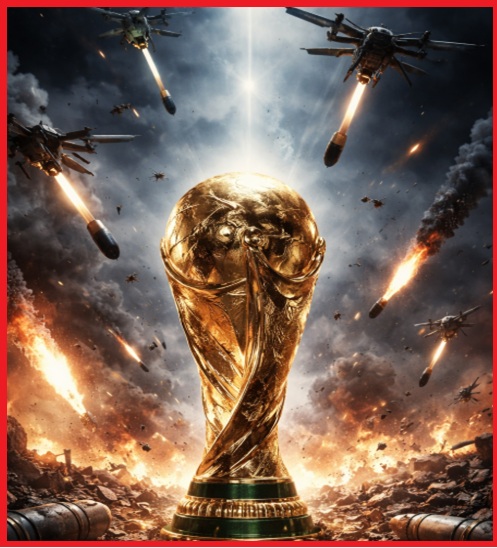
Donyamali said: “Considering that this corrupt regime has assassinated our leader, under no circumstances can we participate in the World Cup. Our children are not safe and, fundamentally, such conditions for participation do not exist. Given the malicious actions they have carried out against Iran … they have killed and martyred thousands of our people. Therefore, we certainly cannot have such a presence.”
A day earlier FIFA president Gianni Infantino had issued a statement of contradictory optimism.
Infantino said: “This evening, I met the President of the United States, Donald J. Trump to discuss the status of preparations for the upcoming FIFA World Cup, and the growing excitement as we are set to kick off in just 93 days.
Trump discussions
“We also spoke about the current situation in Iran, and the fact that the Iranian team have qualified to participate in the FIFA World Cup 2026. During the discussions, President Trump reiterated that the Iranian team is, of course, welcome to compete in the tournament in the United States.
“We all need an event like the FIFA World Cup to bring people together now more than ever, and I sincerely thank the President of the United States for his support, as it shows once again that Football Unites the World.”
The withdrawal of Team Melli, one of the established powers of Asian football, would represent the most significant political boycott of a sporting event since the Cold War. Iran, who dominated the Asian qualifying rounds to secure their spot last March, are scheduled to compete in Group G alongside Belgium, Egypt, and New Zealand. All three of Iran’s group matches are scheduled to be staged on US soil: two in Los Angeles and one in Seattle.
In fact, FIFA is facing a more immediate problem with Iraq due to contest an intercontinental qualifying playoff in Mexico at the end of the month. A closure of the local air space means the Iraqi players face a 24-hour road trip out to Turkey while visa provisions are in doubt.
Iraq challenge
FIFA needs to resolve the Iraq issue before it can address the Iran participation. Time is running out.
Speculation is already mounting over which Asian side might step in to fill the void but the logistical hurdles are immense. Iran had already selected the Kino Sports Complex in Tucson, Arizona, as its base camp. The sudden vacancy of an 18-month preparation plan leaves the local Arizona economy facing a significant hit and the tournament schedule in disarray.
Furthermore, the secondary ticket market is bracing for a shockwave. Iranian fans, known for their fervent support, had purchased tickets for the Los Angeles matches at “eye-watering prices.” Should the boycott be finalised, thousands of seats in the SoFi Stadium may be flooded back onto the resale market, or worse, remain as silent, empty reminders of the conflict.
The internal stability of Iranian football is also fracturing. The men’s team’s uncertainty follows a series of high-profile defections within the women’s programme. This week, Australia granted humanitarian visas to five members of the Iranian women’s team after they sought asylum.
The players reportedly feared persecution upon their return to Iran after refusing to sing the national anthem during a Women’s Asian Cup match — a potent act of defiance against the now-shattered leadership in Tehran.
On Wednesday, the drama intensified as Australian police assisted two more members of the women’s delegation in slipping away from their government-appointed minders. In a sign of the immense pressure and conflicting loyalties currently tearing at the fabric of the nation, one of those players reportedly changed her mind and chose to return to Iran, according to the Australian Interior Minister.
Some reports have speculated that the player had been a ‘plant’ to find the location of the safe house in which the others players were staying. They have now been moved to another site.
####