Infantino delivers homily on ‘joy and happiness’ to World Economic Forum
JONATHAN SHALLARD REPORTING —- Overshadowed by President Trump as he was, FIFA president Gianni Infantino was also at the World Economic Forum in Davos, trying to call up a little global attention on sport, economics and the political significance of this year’s World Cup finals.
Against a backdrop of heightened geopolitical debate at the annual gathering of world leaders and business elites, Infantino used his platform to champion football’s unifying power — while also engaging in sharp defence of FIFA policies and an unexpected cultural jest that stirred controversy.
Standing before a packed audience of diplomats, corporate executives and policymakers, Infantino framed football as a force that transcends politics and economic divides. He said the World Cup finals in Canada, Mexico and the United States exemplify moments of “joy and happiness” that are increasingly rare in a world fraught with conflict and uncertainty.
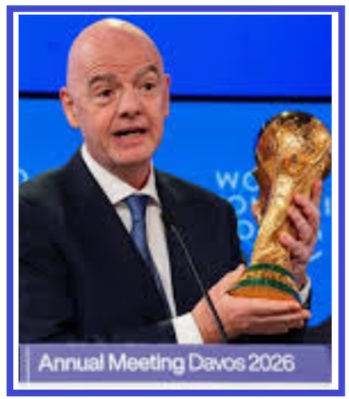
According to Infantino, football’s global appeal compels the world to “stand still,” offering communities from every continent a shared experience of celebration and togetherness.
Highlighting the economic impact of the expanded 48-team tournament, Infantino cited FIFA’s own data suggesting the event could generate more than USD 80 billion in gross output globally, boost GDP by nearly USD 41 billion and support over 800,000 jobs worldwide.
Such projections, he argued, demonstrate sport’s potential not merely as entertainment but as a significant economic engine — especially important in volatile global markets.
Infantino’s remarks were punctuated by a strong defence of FIFA’s organisational choices and ticketing strategy for the 2026 competition. Facing mounting criticism about the steep cost of tickets — with the second-cheapest category for the final priced at over US$4,000 and only limited availability in the budget tier — Infantino acknowledged the backlash but dismissed it as an inevitable part of staging such a monumental event.
“We were hammered… because they are so expensive,” he said, before emphasising unprecedented demand, with FIFA reporting more than 500 million ticket requests in the latest window.
That defence, however, did not go unchallenged. Representatives of supporter groups, particularly in England and Germany — countries he name-checked in addressing critics — criticised his comments, saying the focus should be on affordable access for fans rather than off-hand cultural barbs.
“Rather than making cheap jokes about our fans, he should concentrate on making cheap tickets,” one supporters’ association responded.
Indeed, Infantino’s attempt at levity — a remark that no British fan was arrested during the 2022 World Cup, which he described as a “special” historical milestone — sparked immediate headlines and debate about tone and appropriateness amid serious global discourse.
While intended as a light-hearted acknowledgment of fan behaviour, critics called the quip a distraction from substantive issues.
Infantino also used his speech to address apprehensions about visa access for fans from countries with challenging travel policies. He firmly rebutted reports suggesting some supporters might be denied entry to the United States, asserting that host nations will welcome fans from across the world and that organisers are committed to ensuring inclusivity.
Perhaps most notably, the speech underscored FIFA’s diplomatic engagements on the sidelines of Davos: Infantino announced plans to visit Pakistan soon to promote the sport’s growth there, and reaffirmed strong ties with U.S. political figures, including President Trump, who has publicly endorsed the World Cup and is expected to participate in the trophy presentation ceremony in summer.
As the world’s attention turns toward the June kick-off in North America, Infantino’s address in Switzerland sought to solidify football’s image as a bridge between cultures and economies — even if the road ahead includes addressing questions from fans, political leaders and critics alike.
########