FIFA WORLD CUP: Infantino, Trump and a betrayed referee . . . maybe Platini was right all along
KEIR RADNEDGE COMMENTARY —- In many ways, FIFA’s overturning of Folarin Balogun’s World Cup suspension is even more serious than the FIFAGate corruption scandal of 2015. That was ‘only’ about individual greed, this is about the integrity of the sport of association football itself.
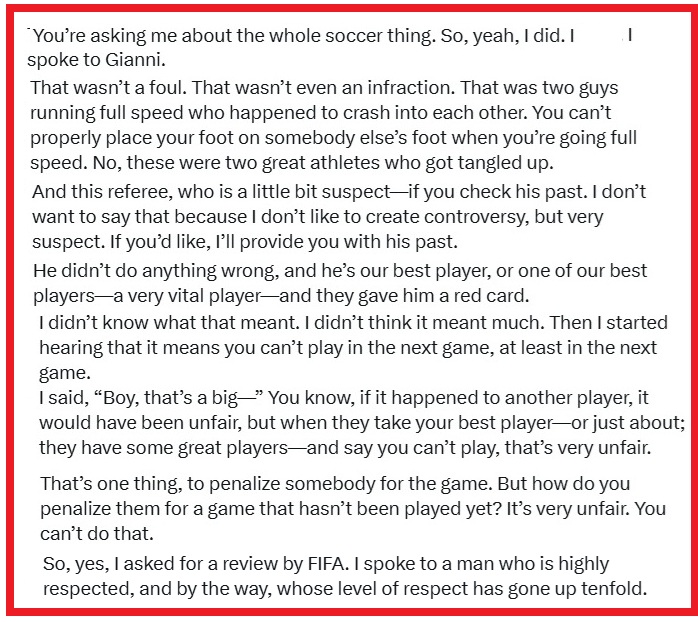
Simply, last week the United States’ top-scoring, three-goal striker was sent off, on VAR advice, for a foul on Tarik Muharemović in the cohosts’ 2-0 victory over Bosnia and Herzegovina in the Round of 32. A direct red card triggers an unconditional, automatic one-match suspension. The decision by Brazilian referee Raphael Claus was judged harsh but what followed was extraordinary.
FIFA, at the request of US President Donald Trump, reviewed the automatic one-game ban and suspended it for a year. Belgium, the Americans’ imminent next opponents, protested that FIFA had broken its own rules. FIFA president Gianni Infantino insisted it had not and, in effect, dared the Belgian federation to do anything about it.
European federation UEFA raged that FIFA had “crossed a red line” with an “unprecedented, incomprehensible and unjustifiable decision.” An automatic match suspension was a pillar of competitive parity, not a discretionary luxury subject to political leverage or mid-event adjustments. UEFA added: “When the certainty of rules is no longer guaranteed by its guardians, the integrity of the game is at stake.”
The Belgian federation said it was considering all options which could only mean an appeal to the tournament panel appointed by the Court of Arbitration for Sport. Of course, an appeal and decision within a 24-hour time frame was always impossible.
Michel Platini, somewhere in France, might have reflected that he had been right all along.
Platini, back in his all-powerful days as head of UEFA and vice-president of FIFA, had opposed the introduction of goal-line technology as pushing football down a slippery slope. He may now feel vindicated. Goal-line technology was followed, at a rush, by video assistance refereeing and the referee’s decision was no longer final, it was open to question and amendment.
The African confederation illustrated that when it reversed the on-pitch victory of Senegal over Morocco in January’s chaotic Cup of Nations Final. Seven months on and CAS has yet to deliver a definitive verdict.
Precedent set
Now, in front of not only African football but the world game, Trump and Infantino have again overthrown a referee’s decision. Trump has been perfectly open about calling Infantino and ‘asking’ for a review. How could FIFA refuse? Predictably, other World Cup finalists are considering whether they can also go to the FIFA disciplinary committee and claim a precedent in support of their own carded players.
By allowing a head of state’s phone call to dictate player eligibility, FIFA has ignored its own statute barring political interference – a hammer it invokes frequently on lesser nations.
If the basic rules of on-field discipline are negotiable for powerful host nations, the foundational equity of not only international football but all international sport goes up in flames. FIFA’s reputation, tawdry enough at this World Cup, has sunk back to that of the bad old days . . . if not worse.
UEFA statement:
— Yesterday’s decision to suspend for a probationary period of a year the implementation of the one-match automatic suspension following the red card issued to the player Folarin Balogun crossed a red line.
Football, like any other sports, relies on rules, which are the basis for fair, honest and transparent competition. Sometimes rules are open to interpretation. In this case not. A minimum automatic suspension of one match following a red card is not a discretionary option and does not require the decision of a competent body to be enacted. It is a principle embedded in regulations, which cannot be made subject to exceptions, let alone in the middle of a tournament where several other players have been in the same situation and regularly served their suspension.
When the certainty of rules is no longer guaranteed by its guardians, the integrity of the game is at stake and the credibility of a competition is undermined. Equally, such decision creates a precedent in the ongoing tournament, where similar situations will now require an equal treatment, to the detriment of the competition.
Football is the most loved sport in the world because it is a beautiful game and is trusted because it is played everywhere with the same laws. A tournament is never a pure standalone and, if the tournament in question is the World Cup, it has the power to drive positive or negative consequences on the game as a whole.
We express our disbelief at such an unprecedented, incomprehensible and unjustifiable decision.
Belgian federation statement:
The Royal Belgian Football Association (RBFA) is astonished by FIFA’s decision to declare suspended United States player Folarin Balogun eligible to play in the USA–Belgium match on Monday, 6 July at 5:00 p.m. (Seattle time).
Update 06/07/2026: Following its previous statement, the RBFA wishes to publicly explain the events of the past few hours.
After learning through media reports of FIFA’s decision to lift the automatic suspension of player Balogun, the RBFA sent a letter to FIFA requesting a copy of the decision, an explanation of the process that had been followed, and setting out its position regarding the applicable regulations.
As its only response, FIFA sent a letter to the RBFA stating that it considered this correspondence to constitute an appeal, that a judge had been appointed, and that the RBFA had only a few hours to complete that appeal. No information whatsoever was provided by FIFA.
For an appeal to be admissible, FIFA’s own regulations state that the reasoned decision must first have been communicated to the appellant. While the RBFA was merely seeking legitimate explanations, FIFA itself created an appeal and immediately ensured that it would be declared inadmissible.
All of this occurred while FIFA simultaneously refused to respond to the RBFA’s legitimate requests.
Furthermore, during the match coordination meeting, FIFA deliberately removed the section concerning the automatic suspension of players from its presentation. This topic had nonetheless been part of all such meetings before each of the previous four matches. The RBFA questioned FIFA, both orally and in writing, about the reasons for this change, yet once again received no response.
To be clear, as of this moment, the RBFA has still not received any decision or any explanation from FIFA regarding this matter. It therefore has no alternative but to challenge the player’s eligibility for the upcoming match.
Regardless of the sporting outcome of this match, the RBFA is deeply concerned by the course of events and will continue to fight in the coming hours, days and months in defence of the fundamental principles of ethics, fair competition, and the interests of football as a whole.
FIFA bases its decision on Article 27 of the FIFA Disciplinary Code. This provision states that the FIFA Disciplinary Committee may decide to suspend the enforcement of a previously imposed disciplinary sanction.
However, Article 66.4 of the same FIFA Disciplinary Code clearly provides that a red card (sending-off) automatically results in a suspension for the team’s next match, as has been the case for all previous red cards issued during this FIFA World Cup.
Furthermore, and irrespective of the above, the decision is in direct contradiction with the provisions of the FIFA World Cup 2026 Competition Regulations, as set out in Article 10.5:
“If a player or team official is sent off as a result of a direct or indirect red card (second caution), they will automatically be suspended from their team’s subsequent match. In addition, further sanctions may be imposed.”
The automatic nature of such a suspension was also explicitly reaffirmed in FIFA World Cup 2026 Circular No. 16, which was distributed to all participating member associations on 12 May 2026.
The same rule is reiterated at every FIFA World Cup 2026 Match Coordination Meeting prior to each match and is included in all FIFA World Cup 2026 workshop presentations.
In order to safeguard the legitimate rights of all participating teams and to protect the fundamental principles of fair play in our sport, both at this FIFA World Cup and at future editions of the tournament, the RBFA is investigating all potential options.
FIFA statement
Statement from the Chairperson of the FIFA Disciplinary Committee – 6 July 2026:
1. On 1 July 2026, during the FIFA World Cup 2026™ match between USA and Bosnia & Herzegovina, USA player Folarin Balogun was sent off on a red card in the 64th minute for serious foul play following a VAR review. After the match, he entered the field of play to celebrate with his teammates despite his expulsion.
2. On 2 July 2026, FIFA opened disciplinary proceedings against Balogun for possible breaches of 66 of the FIFA Disciplinary Code (expulsion and match suspension related to the red card) and Article 14 of the FIFA Disciplinary Code (misconduct of players related to the celebration).
3. On 5 July 2026, the FIFA Disciplinary Committee found Balogun guilty of both infringements, imposed a one-match suspension (suspended on probation for one year) and a USD 40,000 fine, and notified the parties of the decision.
4. With respect to the sporting sanction, the FIFA Disciplinary Committee imposed a one-match suspension. The decision specifically stated that this suspension included the automatic suspension that would otherwise have been served in the forthcoming FIFA World Cup match USA v. Belgium, scheduled for 6 July 2026. In practical terms, absent any further measure by the FIFA Disciplinary Committee, Balogun would have been ineligible to participate in that match.
5. However, the FIFA Disciplinary Committee went on to apply Article 27 of the FIFA Disciplinary Code, under which it has discretion to suspend the implementation of any disciplinary measures, and ordered that the implementation of the one-match suspension be suspended for a probationary period of one year. As a result, Balogun is not required to immediately serve the suspension. Instead, the sanction remains dormant during the probationary period and will only be activated if he commits another infringement of a similar nature and gravity during that one-year period. Should such a subsequent offence occur, the suspended one-match ban would be enforced in addition to any new sanction imposed for the later misconduct.
6. In addition to the suspended match ban, the FIFA Disciplinary Committee imposed a fine of USD 40,000, allocating half of the amount to the violation of Article 14 of the FIFA Disciplinary Code and half to the violation of Article 66 of the FIFA Disciplinary Code. The U.S. Soccer Federation was declared jointly liable for payment of the fine pursuant to Article 6.5 of the FIFA Disciplinary Code.
7. Firstly, the FIFA Disciplinary Committee (as any other FIFA judicial body) is independent as provided by the FIFA Statutes and the FIFA Disciplinary Code. The chairpersons, deputy chairpersons and other members of the FIFA judicial bodies fulfil the independence criteria as defined in the FIFA Governance Regulations to ensure their impartiality.
8. Secondly, the FIFA Disciplinary Committee did not reverse the referee’s on-field sending-off of Mr. Balogun but rather the FIFA Disciplinary Committee upheld the one-game suspension of Mr. Balogun as a result of the red card he was shown during on July 1, 2026. The FIFA Disciplinary Committee only decided on the further disciplinary sanctions to be imposed following the red card.
9. Article 66.4 of the FIFA Disciplinary Code states that “a sending-off automatically incurs suspension from the subsequent match”. Similarly, Article 10.5 of the Regulations for the FIFA World Cup 26™ provides that “if a player or team official is sent off as a result of a direct or indirect red card (second caution), they will automatically be suspended from their team’s subsequent match. In addition, further sanctions may be imposed.”.
10. Consistent with Article 27 of the FDC, the FIFA Disciplinary Committee decided to suspend for a probationary period of one (1) year the implementation of the automatic match suspension it imposed under Article 66.4 of the FIFA Disciplinary Code and Article 10.5 of the Regulations for the FIFA World Cup 26™. Said suspension of the implementation was decided considering all of the specific circumstances surrounding the incident and evidence available.
11. Under Article 27 of the FDC, the FIFA Disciplinary Committee has the discretion to suspend the implementation of any disciplinary measures so long as they do not relate to match manipulation—which, of course, did not occur here. It should be added that employment of art. 27 FDC is not unprecedented, as similar decisions have previously been issued during the FIFA World Cup 2026 qualifiers.
12. There are no provisions in the FIFA Disciplinary Code and the Regulations for the FIFA World Cup 26™, that prohibit the FIFA Disciplinary Committee from exercising its discretion under Article 27 of the FIFA Disciplinary Code. The exercise of such discretion is fully consistent with the general guiding principles for the determination of the applicable disciplinary sanction pursuant to Article 25 of the FIFA Disciplinary Code.
13. Reviewing the legal consequences of red cards in football is nothing new in the modern game. For instance, in the majority of top-tier leagues belonging to UEFA-affiliated member associations – the overturning of red cards is a common disciplinary measure, yet this has never raised concerns about crossing any “red line”. And again, it should be emphasised that in the decision under scrutiny, the red card was not overturned. Suspending the effects of a red card based on an explicit provision of the applicable regulations is a much more balanced measure.
###########